
Loading page
bởi Mateo Q.
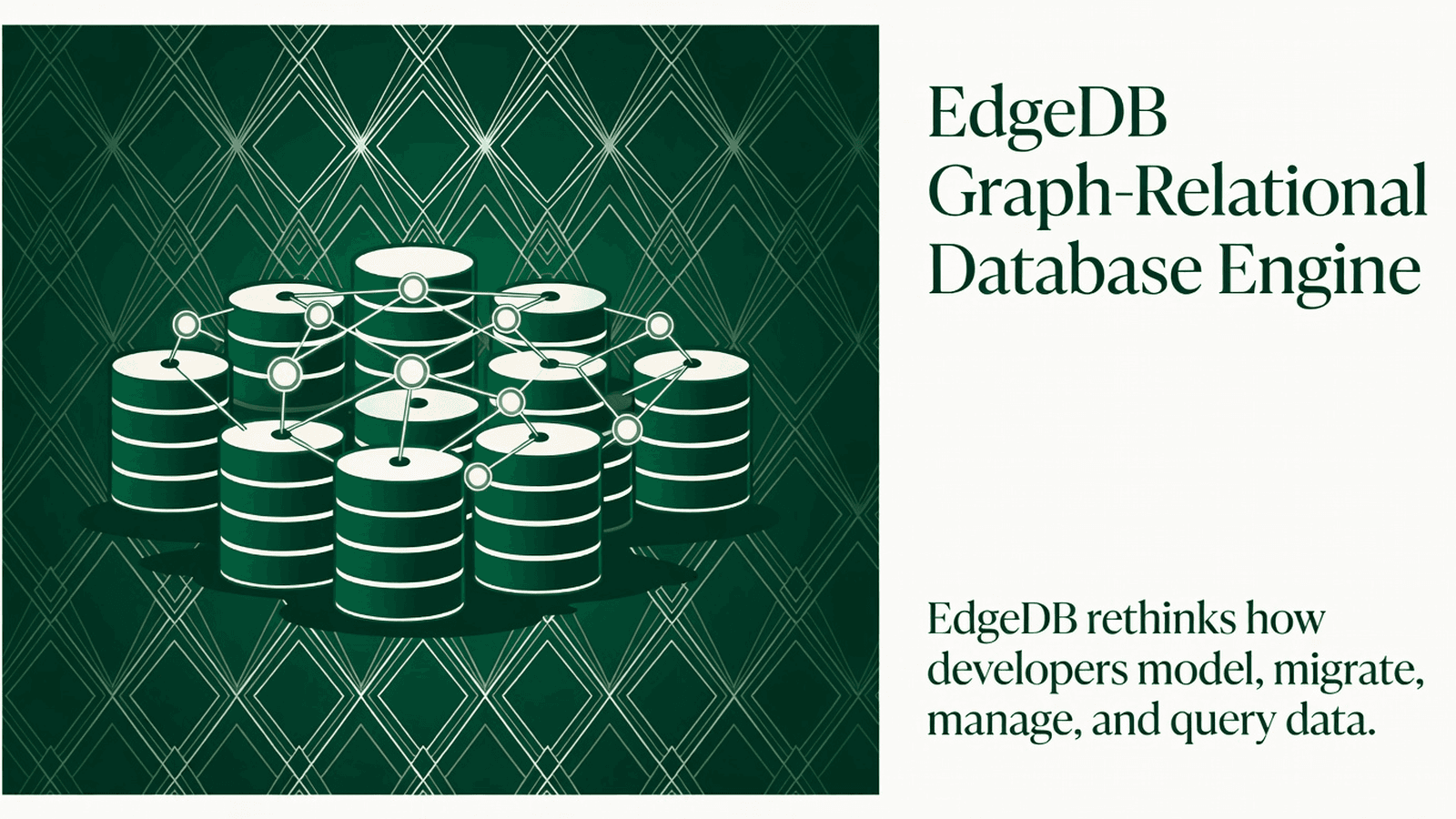
EdgeDB is a graph-relational database combining the best of relational DBs, graph databases, and ORMs. It features the EdgeQL query language, schema-as-types, a smart connection pool, and a full compiler pipeline targeting PostgreSQL.
This block provides the full Gel (formerly EdgeDB) graph-relational database engine source (edb), including the EdgeQL query language, schema system, PostgreSQL backend, server runtime, GraphQL bridge, and protocol layer. It is intended for backend engineers embedding, extending, or running the Gel server directly within a Python or polyglot infrastructure project.
api/ - Public API surface definitions including error codes and type descriptorscli/ - Command-line interface entry points for the gel/edgedb CLI toolcommon/ - Shared utilities: AST base, markup rendering, type utilities, parsing helpers, async toolsedgeql/ - EdgeQL language parser, compiler, and formatteredgeql-parser/ - Low-level Rust-backed EdgeQL parser bindingserrors/ - Structured error classes for the database enginegraphql/ - GraphQL schema translation and query execution bridgegraphql-rewrite/ - GraphQL query rewriting utilitiesir/ - Intermediate representation for compiled querieslanguage_server/ - LSP (Language Server Protocol) implementation for EdgeQLlib/ - Shared native libraries and runtime support filesload_ext/ - Extension loading mechanism for the serverpgsql/ - PostgreSQL backend: code generation, introspection, delta compilationprotocol/ - Binary protocol implementation for client-server communicationschema/ - Schema definition, reflection, and migration systemserver/ - Core database server: connection handling, compiler service, pgcontestbase/ - Testing utilities and base classes for integration teststools/ - Developer tooling and code generation scripts__init__.py - Package rootbuildmeta.py - Build metadata (version, hash)This is a Python package, not an npm package. There is no npm install step for the engine itself. The engine requires Python 3.11+ and the following system-level setup:
# Python dependencies (install via pip into your virtualenv)
pip install edgedb
pip install click
pip install httptools
pip install uvloop
pip install immutables
pip install psutil
pip install cryptography
pip install PyYAML
pip install setuptools
pip install Cython
pip install asyncpg
Khởi chạy sandbox cách ly và chạy phía máy chủ — không cần cài đặt cục bộ.
Tetrees AI Review cho phiên bản này
This Python cli / script completed archive review with strong static results. Structure, dependency manifests, documentation, functional source, and common risk patterns were checked by the Tetrees verification pipeline; runtime phases are stated separately.
Deterministic AVCP artifact review
Quy trình avcp-2026-08-04.1 · SHA-256 31843f3a29698ee6…
This version-scoped review deterministically inspects the submitted archive for structure, dependencies, documentation, functional source, and common malicious or high-risk signals. Build and test phases are reported as passed only after an isolated sandbox audition. It is not a guarantee of perfect security.
Đã đánh giá 4 thg 8, 2026
Đưa sản phẩm này thẳng vào AI IDE, trình tạo web hoặc cloud IDE của bạn.
Download your licensed source snapshot from the library, then follow the setup guide in your workspace.
Chưa có đánh giá.
Sign in to join the discussion
Loading discussion…
For native build steps (required to compile the Rust-backed parser):
# Rust toolchain required for edgeql-parser
curl https://sh.rustup.rs -sSf | sh
source $HOME/.cargo/env

# Build the Rust parser extension
python setup.py build_ext --inplace

# PostgreSQL 15+ must be available on PATH
# On macOS:
brew install postgresql@15
# On Ubuntu/Debian:
apt-get install postgresql-15
Clone or copy the source/ directory into your project root as edb/.
Ensure your PYTHONPATH includes the project root so import edb resolves:
export PYTHONPATH=/path/to/your/project:$PYTHONPATH
Build the native Rust parser extension from the project root:
cd /path/to/your/project
python setup.py build_ext --inplace
Set required environment variables:
export EDGEDB_SERVER_DATADIR=/var/lib/gel/data
export EDGEDB_SERVER_PORT=5656
export EDGEDB_SERVER_BIND_ADDRESS=127.0.0.1
# For development mode (enables extra diagnostics):
export EDGEDB_DEVELOPER=1
Initialize a data directory and start the server:
python -m edb.server --data-dir $EDGEDB_SERVER_DATADIR --port $EDGEDB_SERVER_PORT
For TypeScript/Node.js projects connecting to the running server, install the official client:
npm install gel
# or
npm install edgedb
No TypeScript exports are available directly - this is a Python engine. The public surface for connecting Node.js/TypeScript applications to a running Gel server is the gel npm client. The engine source symbols below are Python-level.
edb.server (module)# Entry point for the Gel server process
python -m edb.server [OPTIONS]
The server module starts the full Gel database server. Use it to embed a managed server process within your infrastructure or to run tests against a live instance.
edb.errors (module)import edb.errors as errors
# e.g. errors.QueryError, errors.ConstraintViolationError
raise errors.QueryError("invalid query syntax", hint="check your filter clause")
Structured exception hierarchy for all database-level errors. Extend or catch these classes when building middleware layers that translate Gel errors to HTTP responses.
edb.common.ast.base (module)from edb.common.ast.base import AST, Field
# Base classes for defining typed AST nodes used throughout the compiler
Provides the foundational AST node base class and Field descriptor used throughout edgeql/, ir/, and pgsql/. Use this when writing custom compiler passes or AST transformations.
A backend service that spawns a local Gel server process and queries it using the official Node.js client.
import { createClient } from "gel";
import { spawn, ChildProcess } from "child_process";
import { setTimeout } from "timers/promises";

async function startGelServer(): Promise<ChildProcess> {
  const server = spawn("python", [
    "-m", "edb.server",
    "--data-dir", process.env.EDGEDB_SERVER_DATADIR ?? "/var/lib/gel/data",
    "--port", "5656",
    "--bind-address", "127.0.0.1",
  ], { stdio: "inherit" });

  // Wait for server to be ready
  await setTimeout(3000);
  return server;
}

async function main() {
  const server = await startGelServer();

  const client = createClient({
    host: "127.0.0.1",
    port: 5656,
    tlsSecurity: "insecure",
  });

  const result = await client.query(`
    select schema::ObjectType { name }
    filter .builtin = false
  `);

  console.log("User-defined types:", result);
  await client.close();
  server.kill();
}

main().catch(console.error);
Express API endpoint that executes parameterized EdgeQL queries.
import express from "express";
import { createClient } from "gel";

const app = express();
app.use(express.json());

const db = createClient({
  instanceName: "my_gel_instance",
  database: "main",
});

app.get("/movies", async (req, res) => {
  try {
    const movies = await db.query(`
      select Movie {
        title,
        actors: { name }
      }
      order by .title
    `);
    res.json(movies);
  } catch (err: any) {
    // Gel query errors have a code property matching edb.errors codes
    res.status(400).json({ error: err.message, code: err.code });
  }
});

app.post("/movies", async (req, res) => {
  const { title } = req.body;
  const movie = await db.querySingle(`
    insert Movie { title := <str>$title }
    unless conflict on .title
    else (select Movie filter .title = <str>$title)
  `, { title });
  res.json(movie);
});

app.listen(3000, () => console.log("API listening on :3000"));
A Node.js migration runner that shells out to the Gel CLI (backed by edb/cli).
import { execFile } from "child_process";
import { promisify } from "util";

const exec = promisify(execFile);

async function runMigration(dataDir: string): Promise<void> {
  // edb/cli/__main__.py exposes the gel CLI
  const { stdout, stderr } = await exec("python", [
    "-m", "edb",
    "--instance", process.env.GEL_INSTANCE ?? "local",
    "migration", "apply",
    "--schema-dir", "./dbschema",
  ], {
    env: {
      ...process.env,
      EDGEDB_SERVER_DATADIR: dataDir,
    },
  });
  if (stdout) console.log("Migration output:", stdout);
  if (stderr) console.error("Migration stderr:", stderr);
}

runMigration("/var/lib/gel/data").catch(console.error);
api/ - Contains errors.txt and types.txt which define the canonical error codes and wire-format type descriptors used by the binary protocol.cli/ - CLI entry point; __main__.py makes python -m edb work, routing to subcommands (server, migration, introspect, etc.).common/ - Foundational utilities: AST base classes, markup/pretty-printing system, async helpers, topological sort, parametric types, structured logging, and more.edgeql/ - Full EdgeQL front-end: lexer, parser, AST definitions, semantic analysis, and query compilation.edgeql-parser/ - Rust-accelerated parser bindings via PyO3; must be compiled before the engine can parse any EdgeQL.errors/ - Complete error taxonomy; every error the engine can raise is defined here with a stable numeric code.graphql/ - Translates GraphQL queries into EdgeQL and handles schema reflection for the GraphQL endpoint.graphql-rewrite/ - Rewrites incoming GraphQL documents to normalize them before translation.ir/ - Compiler intermediate representation: typed query graphs sitting between EdgeQL AST and SQL codegen.language_server/ - LSP server for IDE integration; provides completion, hover, and diagnostics for .esdl and .edgeql files.lib/ - Bundled shared libraries and any pre-built native artifacts.load_ext/ - Plugin/extension loader used at server startup to register custom types and functions.pgsql/ - PostgreSQL backend: IR-to-SQL compilation, DDL delta generation, catalog introspection, and connection management.protocol/ - Binary protocol encoder/decoder implementing the Gel wire protocol versions.schema/ - Schema object model, reflection queries, constraint system, and migration delta computation.server/ - Async server core: client connection handling, compiler service pool, pgcon pool, and HTTP/binary endpoint dispatch.testbase/ - Shared test fixtures, server lifecycle helpers, and assertion utilities for the engine's own test suite.tools/ - Code generation scripts (e.g., generating Python from .txt API definitions).buildmeta.py - Exposes BUILD_VERSION, BUILD_DATE, and related metadata for runtime version reporting.ImportError on edb._edgeql_parser at startup. Fix: run python setup.py build_ext --inplace from the project root before starting the server.FileNotFoundError: pg_ctl. Fix: ensure pg_ctl (PostgreSQL 15+) is on PATH and EDGEDB_SERVER_POSTGRES_DSN or bundled Postgres is configured.python -m edb.server --bootstrap-only --data-dir <dir> once before normal startup.EDGEDB_DEVELOPER not set: Some internal diagnostics and developer-only CLI commands are silently unavailable. Fix: export EDGEDB_DEVELOPER=1 in your dev environment.match statements and other Python 3.10+ syntax. Fix: use Python 3.11+ exclusively; check with python --version.gel client enforces TLS by default in production. Fix: set tlsSecurity: "insecure" in development or provide a proper certificate via --tls-cert-file server flag.I have the Gel (EdgeDB) database engine source located in `source/` (Python package `edb`).
I also have a `USAGE.md` file describing the source layout, setup steps, and working examples.
Please help me integrate this into my existing project step by step:
1. Read `USAGE.md` and `source/` to understand the engine structure.
2. Set up the Python environment: install dependencies from the "Required dependencies" section of USAGE.md.
3. Build the Rust-backed `edgeql-parser` native extension.
4. Configure environment variables for the server (data dir, port, bind address).
5. Wire up server startup (either as a subprocess from Node.js or as a direct Python service).
6. Connect my Node.js/TypeScript application to the running Gel server using the `gel` npm package.
7. Write the schema for [MY DOMAIN OBJECTS] in `dbschema/default.esdl`.
8. Apply migrations using the CLI entry point in `source/cli/`.
9. Add Express API endpoints that query Gel using parameterized EdgeQL.
10. Handle Gel errors gracefully by inspecting the error `code` field.
My project stack: [DESCRIBE YOUR STACK HERE - e.g., Node.js 20, TypeScript 5, Express 4, PostgreSQL 15 available on host].
The upstream project is `edgedb`/`gel`. Source is in `source/`. Follow the patterns in USAGE.md exactly.
The Gel engine source is licensed under the Apache License 2.0. See source/LICENSE if present, or refer to the upstream repository for the full license text. This block is derived from the geldata/gel open-source project.
This product’s unique contribution is clean room implementation of valuable code block into AVCP compatible standard.
Hướng dẫn cài đặt đầy đủ và prompt tích hợp sẽ mở khóa sau khi mua.
Automation, Utilities & Developer Tools
Miễn phí


